 SkinStratos
Formaldehyde releasers: what “releases formaldehyde” on a label means
Some shampoos and body washes now carry the words “releases formaldehyde”. The warning is new, and it isn’t about formaldehyde being added. Here’s what it means.
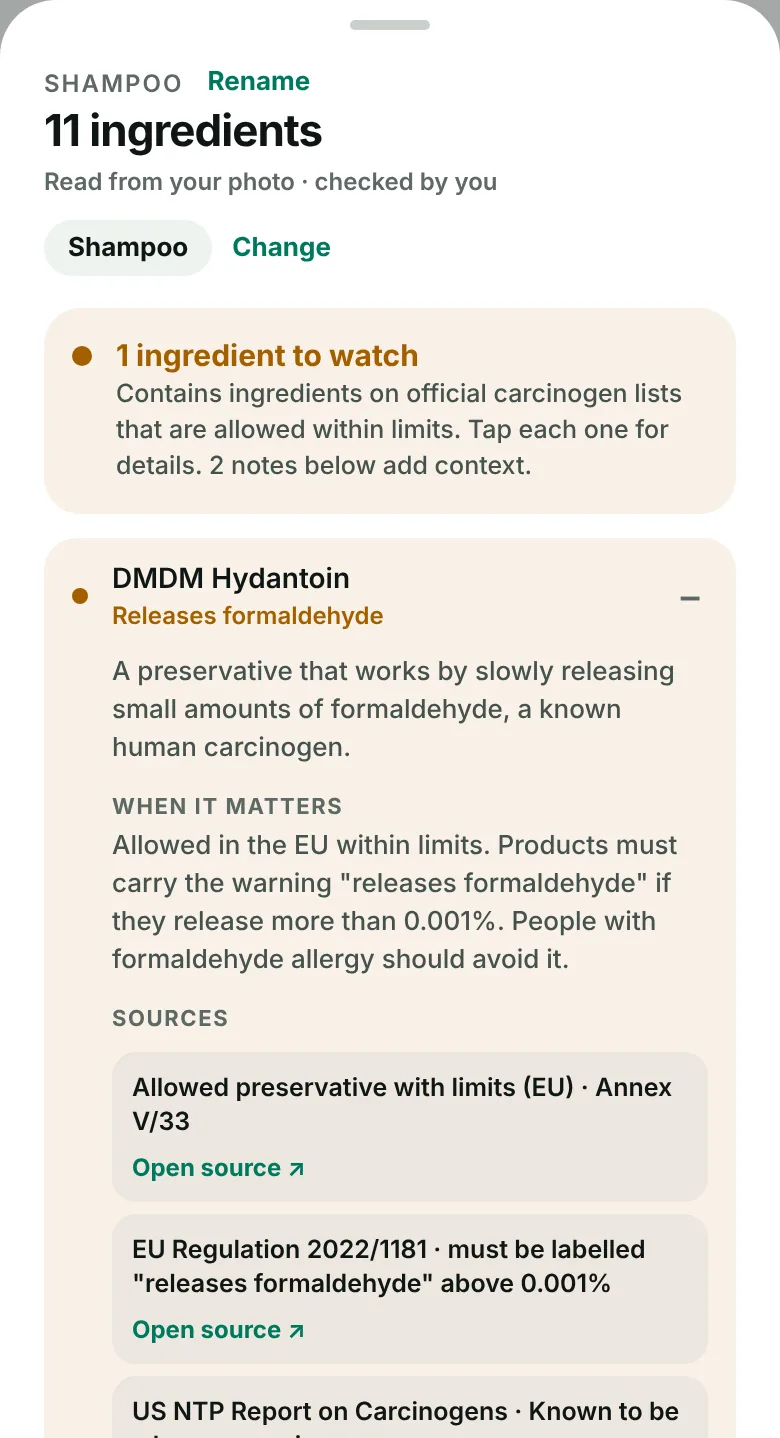
What a formaldehyde releaser is
Water-based products need a preservative, or bacteria and mould grow in them within weeks. A few preservatives work by slowly releasing tiny amounts of formaldehyde, which kills microbes. On labels they appear as DMDM Hydantoin, Imidazolidinyl Urea, Diazolidinyl Urea, Sodium Hydroxymethylglycinate and 2-Bromo-2-Nitropropane-1,3-Diol (bronopol). You’ll find them mostly in rinse-off products such as shampoos, conditioners and shower gels.
The new warning
EU Regulation 2022/1181 lowered the point at which a product must warn you. If the total formaldehyde released in a finished product is more than 0.001% (10 parts per million), its label must say “releases formaldehyde”. The old warning, “contains formaldehyde”, only applied above 0.05%, fifty times higher.
- Since 31 July 2024, products newly placed on the EU market must carry the warning.
- From 31 July 2026, products without it can no longer be sold, even if they were made earlier.
Formaldehyde itself is banned
Formaldehyde is classed in the EU as a category 1B carcinogen, and it can no longer be used as an ingredient in EU cosmetics. One releaser, Quaternium-15, is banned as well. The others are still allowed, each up to a set maximum, because the amounts they release are small.
Why it matters for your skin
At the levels allowed in cosmetics, the main issue is skin allergy. Formaldehyde is a common contact allergen, and people who react to it can also react to products with releasers. If a dermatologist has told you that you’re allergic to formaldehyde, the warning and the ingredient names above are what to look for.
What you can do
- Look for “releases formaldehyde” near the ingredient list, and for the releaser names above.
- A product without the warning can still contain a releaser below the 0.001% threshold, or have an older label until July 2026, so the ingredient list is the surer check.
- In SkinStratos, formaldehyde releasers are flagged for everyone, with the EU source for each one.
Sources
- EU Regulation 2022/1181 (“releases formaldehyde” warning)
- CosIng: Annex II (prohibited) and Annex V (preservatives)
- EU Cosmetics Regulation 1223/2009