 SkinStratos
Cosmetics in pregnancy: ingredients to check
Most cosmetics are fine to keep using in pregnancy. A small number of ingredients appear on official lists because they can affect an unborn child or fertility. Here is what those lists say, so you can talk it through with your doctor or pharmacist.
This guide is information, not medical advice. Every pregnancy is different: ask your doctor, midwife or pharmacist before you stop or start a product, especially a prescription one.
Retinoids (vitamin A)
Prescription retinoids such as tretinoin and isotretinoin are on California’s Proposition 65 list as causing birth defects. They are medicines, not cosmetic ingredients, and aren’t allowed in EU cosmetics.
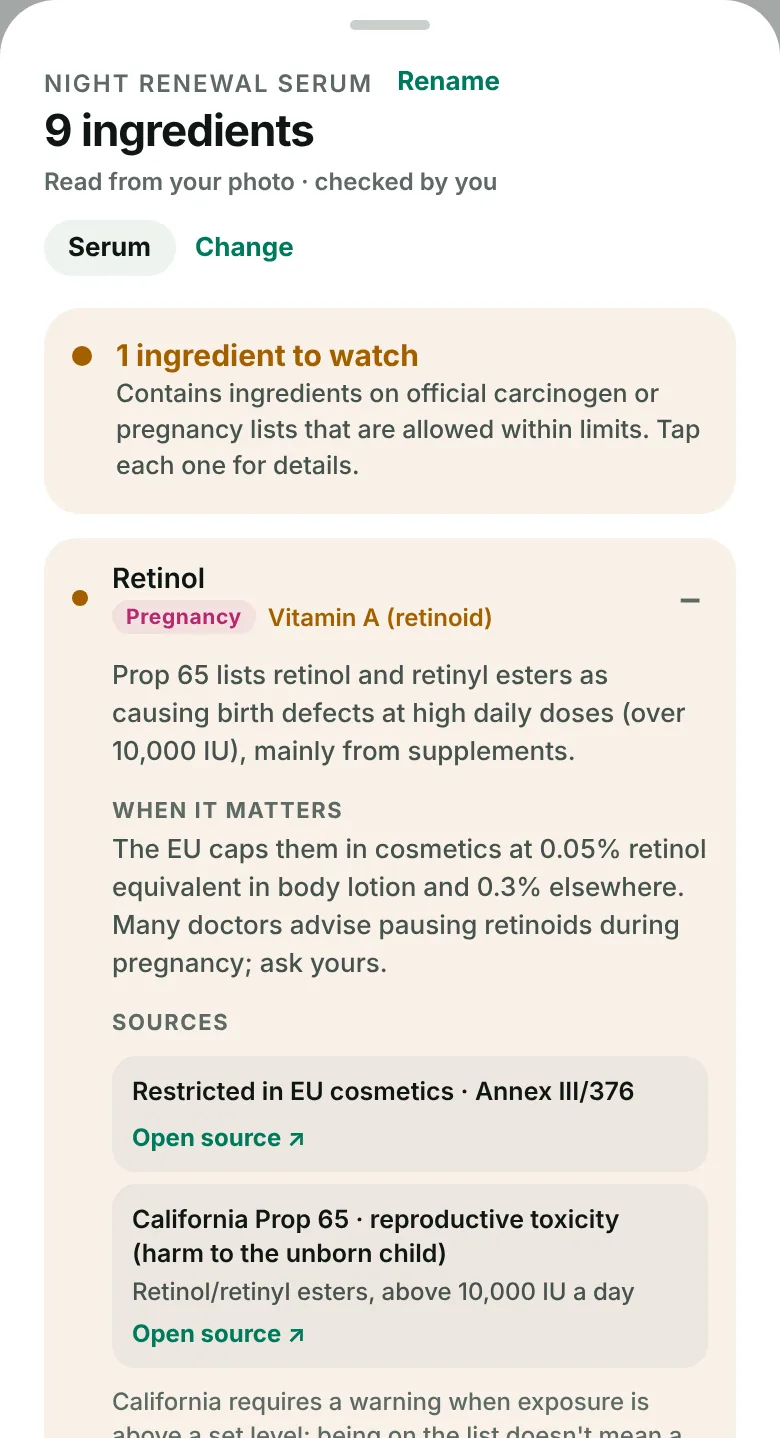
Retinol and its esters (Retinyl Palmitate, Retinyl Acetate) are in many anti-ageing creams. Proposition 65 lists them as causing birth defects at high daily doses, above 10,000 IU, which mainly concerns supplements. The EU caps them in cosmetics at 0.05% retinol equivalent in body lotions and 0.3% in other products. Many doctors still advise pausing retinoids during pregnancy.
Salicylic acid
Salicylic Acid, the exfoliating acid in many acne products and peels, is classified by the EU as suspected of damaging the unborn child (category 2). It’s allowed in cosmetics within limits: up to 3% in rinse-off hair products, 2% in most others, and 0.5% in body lotions and some make-up such as lipstick and mascara. Ask before using peels or leave-on acids.
Phthalates
Some phthalates, such as dibutyl phthalate (DBP) and diethylhexyl phthalate (DEHP), are EU category 1B reproductive toxicants and are on the Proposition 65 list. They’re banned in EU cosmetics, but can still turn up in fragrances, nail polish or packaging from outside the EU.
Nail polish solvents
Toluene helps nail polish spread and dry. The EU classifies it as suspected of harming the unborn child and allows it only in nail products, up to 25%. Paint your nails in a well-ventilated room.
Some silicones
The silicone D4 (Cyclotetrasiloxane) is classified by the EU as suspected of damaging fertility and is banned in EU cosmetics. Cyclomethicone, a mix of silicones, can contain it, though makers now mostly use other silicones.
What you can do
- Read the ingredient list of the products you use every day, especially those you leave on your skin.
- Bring the list to your doctor or pharmacist if you’re unsure about a product.
- In SkinStratos, switch on pregnancy mode to flag these ingredients when you scan. Because this setting says something about your health, the app saves it only with your explicit consent, and you can delete it at any time.
Sources
- California Proposition 65 list (OEHHA)
- CosIng: Annex II (prohibited) and Annex III (restricted) substances
- EU Cosmetics Regulation 1223/2009