 SkinStratos
Preservatives in cosmetics: parabens, MI and what EU law allows
Parabens, methylisothiazolinone, formaldehyde releasers: preservatives get a lot of attention. Here’s why products need them, what EU law allows, and which ones are worth knowing about if your skin reacts.
Why products need preservatives
Anything that contains water, from shampoo to moisturiser, can grow bacteria and mould once it’s opened. A contaminated product can irritate or infect skin and eyes. Preservatives prevent that. In the EU, a cosmetic can only use preservatives from an approved list, Annex V of the Cosmetics Regulation, each up to a set maximum.
Parabens
Parabens are among the most studied preservatives. The EU acted on them in 2014:
- Five parabens were banned because there wasn’t enough safety data: isopropylparaben, isobutylparaben, phenylparaben, benzylparaben and pentylparaben.
- Propylparaben and butylparaben were limited to 0.14% in total, and they aren’t allowed in leave-on products for the nappy area of children under three.
- Methylparaben and ethylparaben remain allowed, up to 0.4% each and 0.8% for all parabens together.
So a paraben on a label in the EU is within limits that EU scientific advisers considered safe. “Paraben-free” on its own doesn’t make a product safer: it has to use another preservative instead.
Methylisothiazolinone (MI)
Methylisothiazolinone became popular as a paraben alternative, and in the 2010s it caused a sharp rise in allergic skin reactions across Europe. The EU banned it in leave-on products from February 2017 and limited it to 0.0015% in rinse-off products. The related mixture of methylchloroisothiazolinone and methylisothiazolinone (MCI/MI) is also limited to rinse-off products.
Formaldehyde releasers
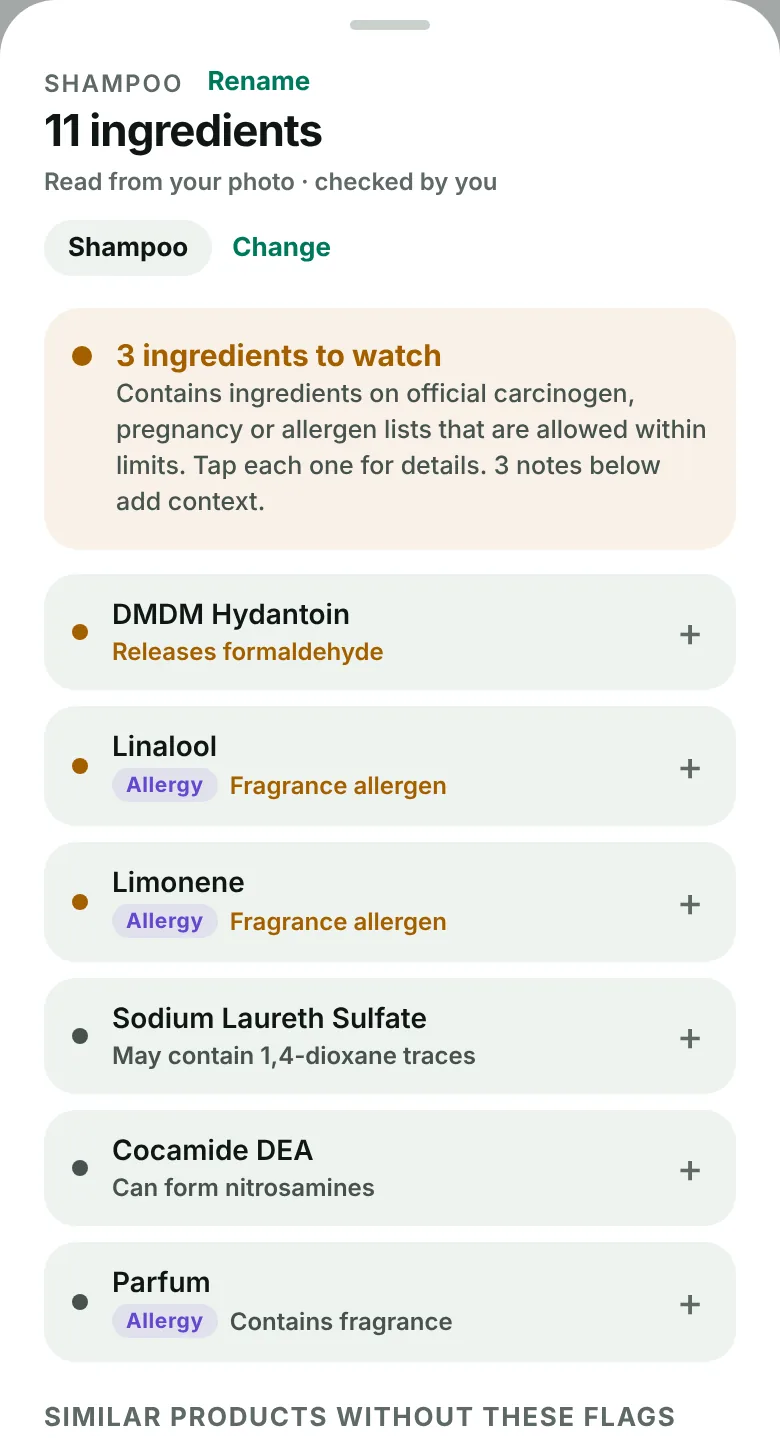
A few preservatives work by releasing small amounts of formaldehyde. They’re allowed within limits, and products releasing more than a very low threshold must say so on the label. Our guide to formaldehyde releasers explains the warning.
If your skin reacts
- The preservatives most often behind allergic reactions are MI, MCI/MI and formaldehyde releasers. Note which ones appear in products that bother you.
- A dermatologist can confirm the cause with patch testing.
- In SkinStratos, allergy mode flags MI and MCI/MI alongside fragrance allergens, and formaldehyde releasers are flagged for everyone.
Sources
- EU Regulation 358/2014 (five parabens prohibited)
- EU Regulation 1004/2014 (paraben limits)
- EU Regulation 2016/1198 (MI banned in leave-on products)
- EU Regulation 2017/1224 (MI limit in rinse-off products)