 SkinStratos
How to read a cosmetic ingredient list
Every cosmetic sold in the EU has to list its ingredients, and the list follows a few fixed rules. Once you know them, a block of Latin and chemical names starts to make sense.
Where to find it
Look for the word “Ingredients” on the outer box, the bottle or the tube. If the pack is too small, EU law lets the brand put the list on a leaflet, tag or card that comes with the product, with a hand-and-book symbol on the pack telling you to look for it.
The order tells you roughly how much
Ingredients are listed from the largest amount to the smallest, by weight when they were added. Water (Aqua) is first in most creams and shampoos because it makes up most of the product.
There’s one catch: anything below 1% can be listed in any order after the rest. So the first five or six ingredients tell you what the product is mostly made of, while the long tail at the end is a mix of small amounts in no particular order. A star ingredient near the end of the list may be there in a tiny amount.
The names are the same in every EU country
Labels use INCI names (International Nomenclature of Cosmetic Ingredients), so a French shampoo and a Romanian one use exactly the same words. That’s why you see Latin for plants and water:
- Aqua is water.
- Butyrospermum Parkii Butter is shea butter.
- Simmondsia Chinensis Seed Oil is jojoba oil.
- Tocopherol is vitamin E.
The EU’s own database of these names, CosIng, is free to search and shows what each ingredient does and any limits on it.
Colours, shades and “nano”
- CI numbers (Colour Index), such as CI 77891 for titanium dioxide, are colours. They can be listed at the end, in any order.
- “May contain” or “+/-” before a group of colours means the list covers a whole range of shades, and your shade contains only some of them.
- “(nano)” after a name means that ingredient is used as a nanomaterial. EU law requires this to be marked.
“Parfum” and the allergens named after it
“Parfum” (or “Aroma” for flavours) stands for a whole fragrance blend, which can contain dozens of substances. The brand doesn’t have to list them one by one, with one exception: known fragrance allergens must be named separately when they’re above 0.001% in products you leave on the skin, or 0.01% in products you rinse off. That’s why you often see Linalool, Limonene or Citronellol at the end of a list. Since July 2026, new products have to name more than 80 of these allergens; our guide to fragrance allergens explains the change.
What the list doesn’t tell you
- Exact amounts. Only the order, and only above 1%.
- Grade and purity. Petrolatum, for example, is only allowed in EU cosmetics in refined grades, but the label looks the same either way.
- Impurities. Traces left over from making a raw material don’t count as ingredients, so they’re not listed. Some ingredients made by ethoxylation, such as Sodium Laureth Sulfate, can carry traces of 1,4-dioxane.
Let the app do the reading
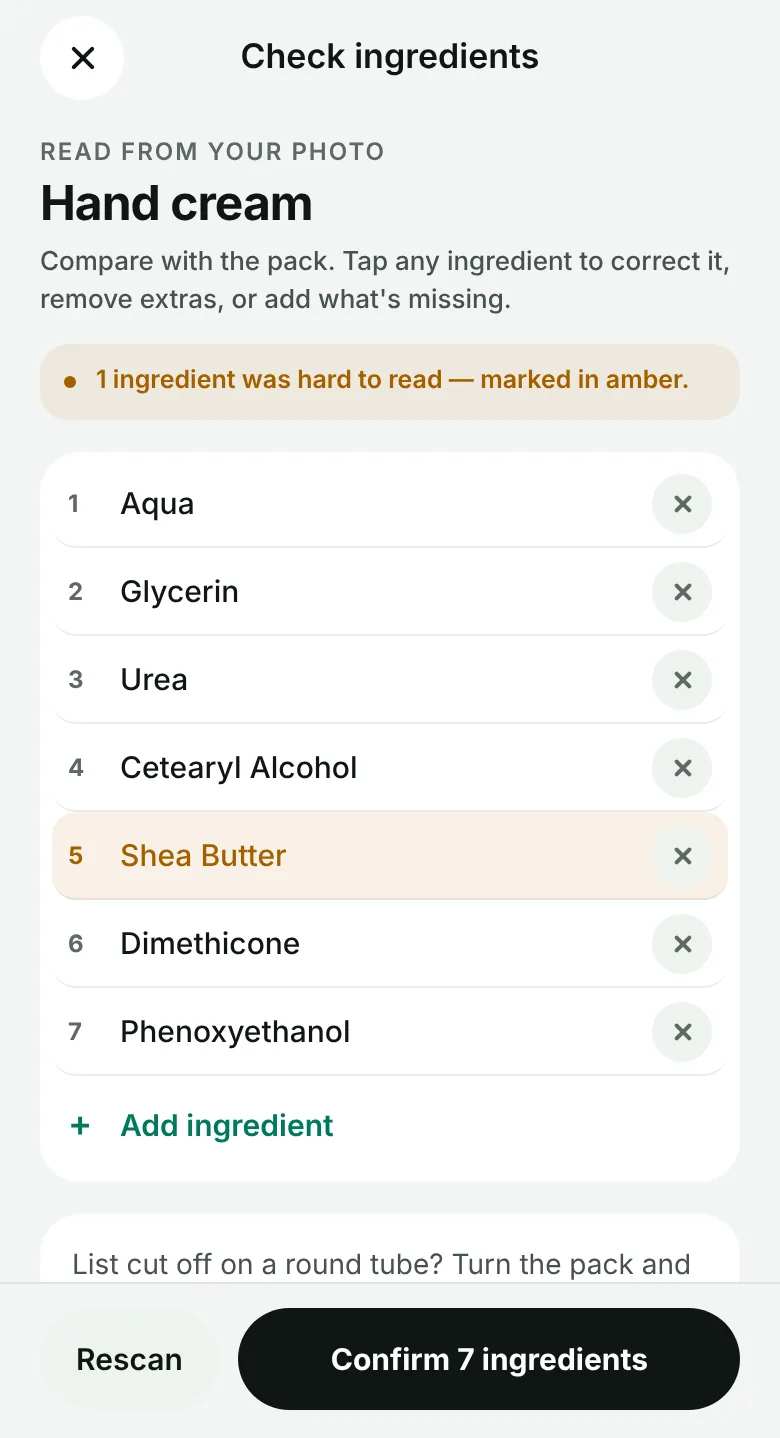
SkinStratos reads the list from a photo or the barcode and checks each ingredient against official EU and US lists for carcinogens, pregnancy and allergens, with the source for every flag. You still decide; the app just does the cross-checking that would take an evening by hand.
Sources
- EU Cosmetics Regulation 1223/2009, Article 19 (labelling)
- EU Regulation 2023/1545 (fragrance allergen labelling)
- CosIng, the EU cosmetic ingredient database